Tashn
Features
One match, start to finish.
The honest way to show what Tashn does is to walk through one match: the two minutes before it, the ten loud minutes of it, everything it leaves behind, and the tournament it can be part of.
Before kickoff
Two minutes from trash talk to kickoff.
No spreadsheet, no sign-up sheet, no 'who's keeping score?'. Pick the table, pick the players, play.
- Venues, not vague locations
- An adda can run several tables - first floor, cafeteria, the good one - and each keeps its own game history.
- A roster built by tapping
- Tap four players onto the yellow and white teams. Profiles and recent form are right there while you argue about pairings.
- Consent before the first goal
- Every player confirms from their own phone before the match starts. Nobody gets scored for a game they never agreed to play.

The table goes live
Scoring that keeps up with the game.
The scorer's phone becomes the table: two full-bleed halves, one tap per goal, everything else automatic.
- Tap-to-score, full bleed
- Each team owns half the screen. A goal is one tap on the scorer's tile - no menus while the ball is rolling.
- Own goals and undo
- Own goals are attributed honestly with a tap of their own, and every goal has an 8-second undo for slipped thumbs.
- Positions tracked live
- Attack/defense switches are logged as they happen, so the stats know who was defending when the wall held.

After the winning goal
It goes on the record. All of it.
A 10-second finalizing window keeps the drama honest - then the game feeds everything an adda argues about.
- An MVP every match
- Each finished game crowns its MVP, so the best shift gets credit even in a loss.
- Boards with receipts
- Leaderboards rank the crew overall and by goals, MVPs, own goals and coins - with a podium for each.
- Profiles that remember
- Streaks, last-five form, teammate chemistry, head-to-head records. The 10-0 from last winter is never up for debate again.

When it counts
Run a foosball tournament in an afternoon.
Pickup games are ambient. A tournament is an occasion: a knockout bracket or a league table with your name in it, a queue of fixtures, and somebody crowned at the end of it.
- Two formats, no maths
- Knockout down to a top-four playoff, or a league where everyone plays everyone. Pick one, set the match target, and the fixtures, byes and seeding are generated for you.
- Registration that closes itself
- One player invites a partner; the team counts once the partner accepts. Accepting cascades away the conflicting entries, so nobody ends up in two teams at once.
- Standings that move as you play
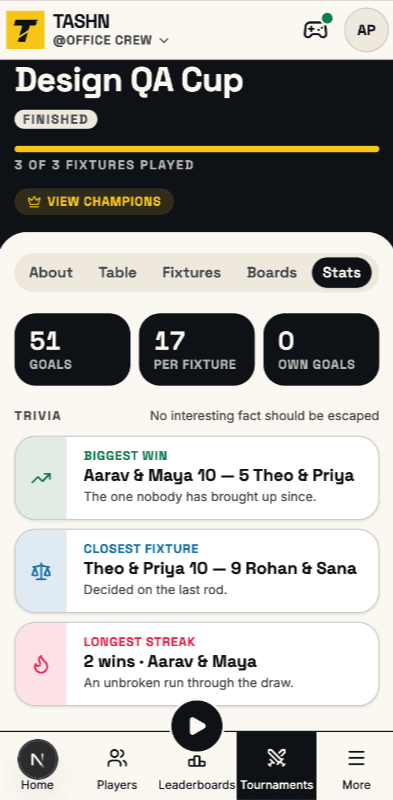
- Each finished fixture advances the bracket and the table in the same beat. Every tournament also keeps its own boards and a stats tab, down to the golden boot, the biggest win, the closest fixture and the longest streak.
- An optional pot, on the ledger (Beta)
- Add an entry fee and prize splits and Tashn tracks who has paid and who is owed, with a UPI QR to collect. People pay each other directly, so Tashn keeps the record and never touches the money.
Your adda runs it
A private clubhouse, owner included.
Everything above happens inside your adda - a space only your crew can see, with real tools for whoever runs it.
- Join your way
- Invite links and codes for friends; same-domain discovery for colleagues, so an office adda fills itself.
- Owner tools that matter
- Roster management, join requests, venues and reports - the boring parts handled in one screen.
- More than one crew
- Office league and flatmates' ladder stay separate: switch addas from the header, each with its own boards.

The spectator wall
Eighteen ways to heckle. All of them count.
Reactions aren't confetti: each one is polarity-tagged and aimed at the game, a team, or a player, and the loudest ones feed back into the match story. The system throws in its own - first blood, hat tricks, comebacks - when the moment earns it.
At the game
For the match itself - the pace, the tension, the entertainment.
- Intense
- Breathtaking Play
- Close one
- Good play
- Entertaining
- Slow pace
At a team
Praise the coordination or call the collapse.
- Smart Play
- Coordination
- Power
- Fightback
- Collapsing
- Infighting
At a player
GOATs, walls and meltdowns, credited to the right person.
- Unbelievable
- GOAT
- Wall
- Lightning
- Desperate
- Embarrassed

In detail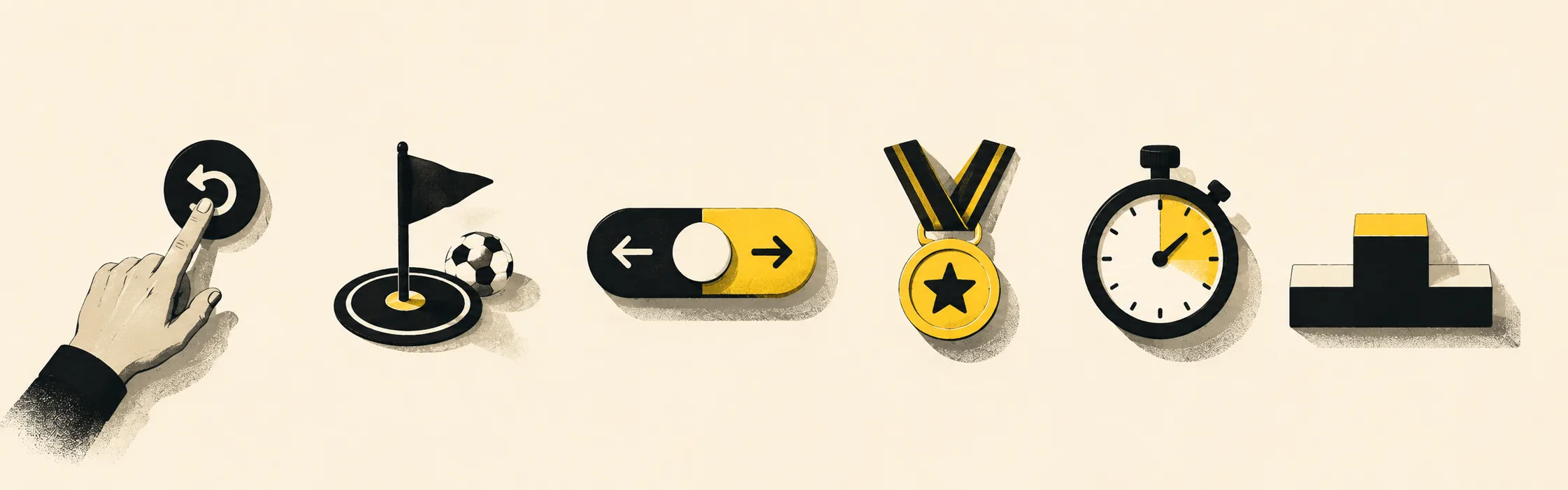
The small things that keep the record honest.
Full-bleed tap-to-score
Each team owns half the screen. Tap a player's tile to add their goal, so scoring keeps up with a fast table without anyone looking away from the game.
Own goals, attributed honestly
An own goal is one tap on the player's tile. It counts against the right team and stays on the record, because the funny ones deserve to be remembered.
An 8-second undo
Every goal has a short undo window. Thumbs slip and the table does not stop, so a misfire is one tap to take back.
Attack and defense, counted apart
Position switches are tracked as they happen, so goals scored on attack and goals conceded on defense are kept separate all game long.
Everyone consents first
Before a match starts, every player confirms from their own phone. No surprise line-ups, no scoring for someone who never agreed to play.
A live spectator wall
Anyone in the adda can watch live: the running score, the goal timeline, and the reactions landing in real time. The bench is part of the game.
MVP every match
Each finished game awards an MVP, so the best shift gets credit even in a loss, and the argument about who carried it has an answer.
Brackets that seed themselves
A knockout pads the field to the next power of two and hands the byes to the top seeds, so an awkward number of teams is the app's problem rather than the organiser's.
A league table with a real tiebreaker
Two points a win, none for a loss, and a tiebreaker chain that runs points, then wins, then net goal margin, then goals scored. Level on points is not left to a coin.
Scoring you can delegate
A tournament keeps its own scorer list. Anyone on it can start the next fixture, so the organiser does not have to be standing at the table for every single match.
Walkovers, counted properly
A no-show is forfeited without a game: the win and the points stand, but nothing lands on anyone's goals, matches played or personal stats.
A champion, and a Player of the Tournament
The last fixture triggers a celebration screen for the winners and an individual award decided on goals per match, with a floor of two matches so byes cannot buy it.
A tournament money ledger (Beta)
Optionally attach an entry fee and prizes. Tashn records who has paid in and who is owed a payout, with a UPI QR to collect, while every rupee moves directly between people. The app keeps the ledger and never holds, processes or takes a cut of the money.
Venues that keep their own history
An adda can run more than one venue, so the first-floor table and the cafeteria table build separate records instead of blurring into one.
Virtual coins, never real money
Stake coins on a game for bragging rights. There is no way to deposit or withdraw real money, and there never will be.
Add it to your home screen
Tashn is a web app. Open it in any phone browser, sign in with Google, and add it to your home screen for the full-screen feel. No app store, no install.
Wondering which games all this applies to? See the lineup.
See it on your own table.
Foosball, live, in under a minute from right now.
Start freetashn.app — free, in your browser